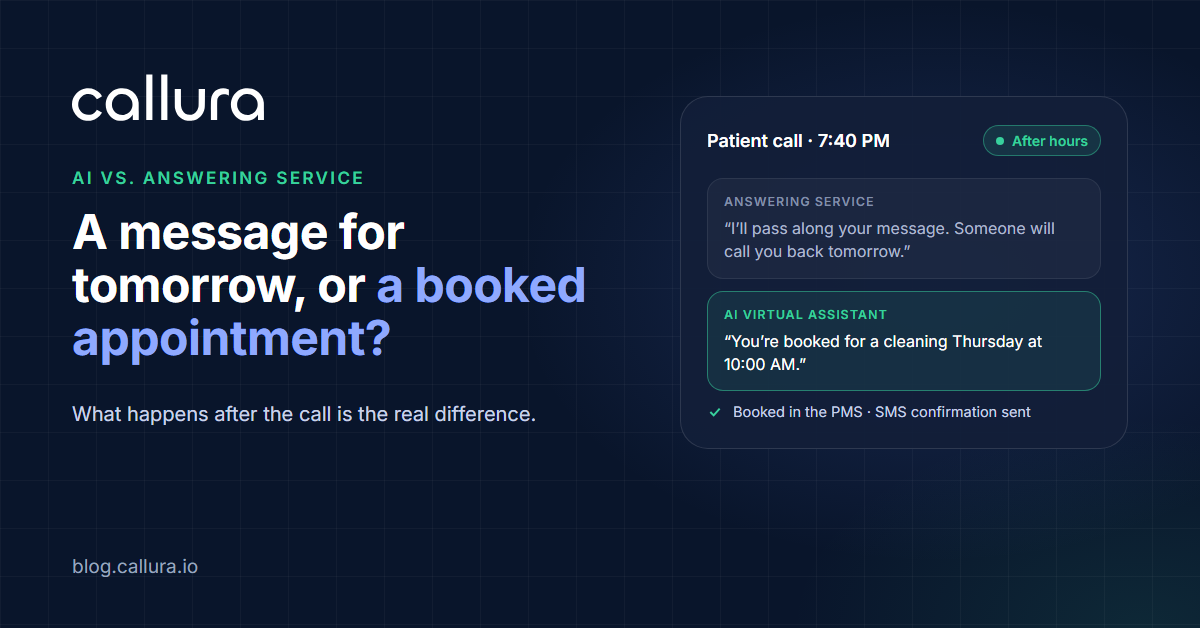
A patient calls your practice at 7:40 PM to book a cleaning. With an answering service, a person takes a message and your team calls back tomorrow. With an AI virtual assistant, the call ends with an appointment on the schedule.
An AI virtual assistant, often called an AI receptionist, answers the call and completes the task, such as booking, rescheduling, or answering a question, directly in your practice management system. A virtual receptionist or answering service is a person who answers on your behalf, usually takes a message, and hands the task back to your team. Which is right depends on the calls you miss, when you miss them, and what you need to happen next.
The three options at a glance
| | Answering service | Human virtual receptionist | AI virtual assistant |
|---|
| Who answers | A call-center agent, often shared across many businesses | A remote person trained on your scripts | An AI voice agent trained on your services and rules |
| Typical outcome | A message for your team | A message or a booking, depending on access | A booking, reschedule, or answer during the call |
| Booking in your PMS | Rarely | Sometimes, with manual entry | Yes, when integrated with your PMS |
| Several calls at once | Depends on staffing | One call per person | Yes |
| Knows your services | Basic script | Good, with training | Good, from your service menu, FAQs, and policies |
| Best for | Overflow messages and emergencies routing | Practices that want a human voice for every call | Practices that want missed calls turned into appointments |
Why a message is not the same as a booking
Many callers who reach voicemail never leave a message. At Xanadu Med Spa in Fort Collins, Colorado, owner Mark Koepsell estimated that only about 10 percent of missed callers did. His explanation: “Probably those people found us on Google and they’ve just gone to the next listing.” Response time matters for the same reason it does with web leads, as we covered in why the first five minutes matter.
An answering service improves on voicemail because a person picks up. But if the call still ends with “someone will call you back,” the patient is waiting, and your team inherits a callback list the next morning. The value of an AI virtual assistant is that the call ends with the job done: the appointment is in the schedule and the patient gets an SMS confirmation.
When an answering service or virtual receptionist still makes sense
- You need a human for every call. Some practices prefer a person on every line, regardless of cost.
- Your calls are mostly complex. If most calls need clinical judgment or negotiation, a person may be a better first touch.
- You only need messages. If the goal is simply to log after-hours calls for the morning, a message service can be enough.
When an AI virtual assistant is the better fit
- Most missed calls are routine. New-patient bookings, reschedules, hours, pricing, and insurance questions are what AI handles well, including insurance eligibility checks during the same call.
- You miss calls at predictable times. The top of the hour, lunch, after close, and weekends are when the front desk is busy or gone.
- You want the booking, not the message. An AI virtual assistant connected to your PMS can check real availability and book during the call.
- You still want a person when it matters. A good AI virtual assistant transfers callers who need your team, or records the details for follow-up when nobody is available.
Three questions that separate the options
- What is the end result of a typical call: a message for our team, or a booking in our system?
- What happens at 2 AM or when five people call at once? Human services depend on staffing; AI does not.
- How are we billed: per minute, per call, or a flat fee? Human services often charge by the minute or by the call. See what an AI receptionist costs.
If you decide an AI virtual assistant fits, our demo checklist covers how to test PMS booking, handoffs, SMS confirmations, and launch time with each provider. To compare specific tools, see our side-by-side comparisons of AI receptionists for dental practices and med spas.
How Callura works
Callura is an AI virtual assistant for dental practices and med spas, built on each practice’s own workflows, services, and FAQs. It answers calls 24/7, books, reschedules, and cancels appointments directly in systems such as Dentrix, Open Dental, Denticon, Eaglesoft, NexHealth, ModMed, Zenoti, Vagaro, and Mindbody, and sends SMS confirmations. When a caller needs a person, Callura transfers the call to your team or leaves a note in your dashboard. Callura goes live in under one week with less than two hours of your team’s time, and signs BAAs.
Read how Xanadu Med Spa stopped losing callers to voicemail, or see how after-hours calls become consultations.
Frequently asked questions
Is an AI receptionist the same as an answering service?
No. An answering service is a person who answers and usually takes a message. An AI virtual assistant, often called an AI receptionist, answers and completes the task during the call, such as booking the appointment in your PMS.
Can an AI virtual assistant transfer calls to a person?
Yes. Callura transfers callers who need your team, based on rules you set, and records the details in your dashboard if nobody is available.
Does an AI receptionist replace the front desk?
No. Many practices use it as backup for overflow, lunch, after-hours, and weekend calls, so the front desk can focus on patients in the office.
See it with your own calls
Bring a typical new-patient call and a reschedule. We will build a demo on your services and walk you through how it answers and books.
Talk to a Founder
About Callura
Callura builds AI virtual assistants for dental practices, med spas, and other healthcare practices, trained on each practice’s workflows, services, and FAQs. They answer calls 24/7, book appointments in your PMS, verify insurance eligibility, and send SMS confirmations. Follow Callura on LinkedIn.
%20(5).svg)